A winter storm leaves a brown water stain on a California ceiling. An inspection finds saturated underlayment, damaged decking, and a roof that has reached the end of its service life. The estimate comes back at $15,000 to $30,000, and the homeowner's first question is rarely about shingles. It's usually, “How can this be paid for without draining the household's reserves?”
That question has become central to financing for roof replacement. A full U.S. roof replacement commonly costs about $9,604 on average, and replacement terms often run from 3 to 12 years, according to guidance on financing a new roof. In California, homeowners also face labor demand, material costs, permitting, and energy-related requirements that can make a replacement estimate feel especially painful.
The practical answer isn't to choose the first payment plan offered at the kitchen table. It's to identify who will pay what, match the loan to the repayment timeline, and avoid turning an urgent roof project into expensive revolving debt.
Table of Contents
- Why Most Homeowners Finance Their Roof Replacement
- Comparing the Main Roof Financing Options
- Understanding Deferred Interest Versus True Zero Percent Plans
- Bridging the Gap When Insurance Does Not Cover the Full Cost
- California Energy Programs That Can Reduce Your Roofing Costs
- How to Qualify and Prepare Your Financing Application
- Example Payment Plans and Next Steps for Your Project
Why Most Homeowners Finance Their Roof Replacement
A California homeowner can have steady income, good credit, and savings, yet still finance a roof replacement. The reason is practical: keeping an emergency reserve may matter more than paying a contractor in one lump sum. Medical bills, tuition, property taxes, and other large obligations do not pause because the roof fails.
Roof work is also difficult to delay safely. A small ceiling stain may indicate moisture intrusion that has already reached insulation, framing, drywall, or interior finishes. Continued leaks can also create problems during a home sale when an inspection identifies active damage or deferred maintenance.
Practical rule: Financing should preserve financial flexibility, not disguise an unaffordable project.
The actual bill often differs from the amount a homeowner expects insurance to pay. A policy may cover a storm-related portion while leaving code upgrades, depreciation, deductibles, ventilation changes, or unrelated wear for the homeowner. That gap is one reason financing becomes part of the replacement plan. An industry summary estimates that roughly 40% of U.S. roof replacements are financed, while replacement costs commonly range from $8,000 to $25,000, and asphalt-shingle projects often fall between $9,000 and $20,000. Those figures appear in a 2026 roof-financing market summary. The payment must fit the household budget, and the borrower must understand the total repayment cost.
California estimates can include tear-off, decking repairs, permits, ventilation work, code requirements, and energy upgrades. A replacement may therefore be part of a larger improvement package rather than a basic shingle installation. Ask the roofer for a written scope that separates required repairs, insurance-covered work, and optional efficiency improvements. That breakdown makes financing decisions more accurate, especially when solar, insulation, or other energy-related work may be bundled with the roof.
Financing is a planning tool
Cash is sensible when it pays for the project without weakening the emergency reserve. Using every available dollar, however, leaves little protection when the next household repair or unexpected bill arrives.
Borrowers considering broader rehabilitation funding may also review alternative doc rehab loans from New American Funding, LLC. That resource may fit a larger rehabilitation plan, but a standard roof replacement usually needs a simpler product with clear funding timing and repayment terms.
Start with three questions:
- What is the complete project cost? Include the roof system, removal, disposal, permits, decking allowances, and approved upgrades.
- What money is already available? Separate insurance proceeds, cash reserves, rebates, and expected reimbursements.
- What payment can the household sustain? A payment that works only in a perfect month is the wrong payment.
Comparing the Main Roof Financing Options
A roof replacement may start with an insurance check that does not cover the complete scope. California homeowners often face added costs for decking, permits, ventilation, code compliance, or energy upgrades. Choose financing after separating the insurer's payment, available cash, and the actual replacement cost.
No single loan fits every borrower. Equity, credit, urgency, repayment capacity, and the project's final scope should drive the choice.
| Financing Type | Typical APR Range | Term Length | Secured? | Best For |
|---|---|---|---|---|
| Home equity loan | 6% to 10% | Fixed installment term | Yes | Owners who want a lump sum and predictable payment |
| HELOC | Variable rate | Draw period plus repayment period | Yes | Owners with equity and uncertain final project costs |
| Personal loan | About 7% to 24% APR in the cited roof-financing guidance | Commonly several years | No | Fast funding without using home equity |
| Credit card | Varies widely by account | Revolving | No | Small, short-term expenses that can be repaid quickly |
| Contractor-arranged financing | 0% to 22% or more | Promotional or fixed installment term | Usually no | Convenience and project-linked applications |
| FHA Title I home-improvement loan | Varies by lender and borrower | Fixed term | May be unsecured or secured depending on amount and structure | Qualified homeowners with limited equity |
| PACE financing | Varies by program and assessment | Property-linked repayment term | Property-tax assessment | Energy-related improvements where the structure fits |
The ranges for contractor financing, personal loans, and equity products are summarized in roof financing guidance focused on insurance gaps. Your actual APR can change with credit history, term, fees, lender requirements, and promotional eligibility. Compare total repayment, not just the monthly figure.
Secured choices
A home equity loan provides one lump sum and a defined payment schedule. It fits a homeowner who has a reliable project price and wants a fixed rate. The home secures the debt, so default can put the property at risk.
A HELOC offers a credit line instead of one fixed draw. That flexibility helps when tear-off reveals uncertain decking or structural repairs. Its variable rate can raise the payment, and the lender may take longer to review income, property value, and available equity.
Use either product only when the household can handle the payment and the secured borrowing risk. Equity also matters when insurance pays only part of the work, because the loan may cover the gap without forcing the homeowner to drain emergency savings.
Unsecured choices
A personal loan does not use the home as collateral and may fund quickly. Current roof-financing guidance describes funding in 1 to 5 days, with APRs of roughly 7% to 24%, while equity products can take 2 to 6 weeks and require available equity. That speed can suit an active leak, but check origination fees and total interest before signing.
Credit cards usually fit only a modest deposit or a short-lived cash gap. Carrying a full replacement balance through multiple billing cycles can make the roof far more expensive.
Contractor and government-linked options
Contractor-arranged financing keeps the application close to the estimate and may simplify project coordination. Convenience does not replace disclosure. Request the regular APR, promotional terms, fees, payoff rules, and payment schedule in writing. Apply the same scrutiny to any financing for home repairs offer used for roofing.
FHA Title I loans can reach $25,000 for home improvements, according to the Federal Housing Administration loan overview. PACE repayment attaches to the property-tax bill rather than operating like a conventional personal installment loan. It may fit energy-focused improvements, but review liens, refinancing, resale, and disclosure requirements before committing.
California homeowners considering solar or other efficiency work should price the entire package, not finance the roof in isolation. A bundled project can change both the needed loan amount and the suitable product. Review roof financing options and compare any contractor-linked plan with an outside personal loan or equity product before signing.
Understanding Deferred Interest Versus True Zero Percent Plans
The words “no interest” don't always describe the same financial product. A homeowner who treats every promotional offer as true 0% financing can receive an expensive surprise at the end of the term.
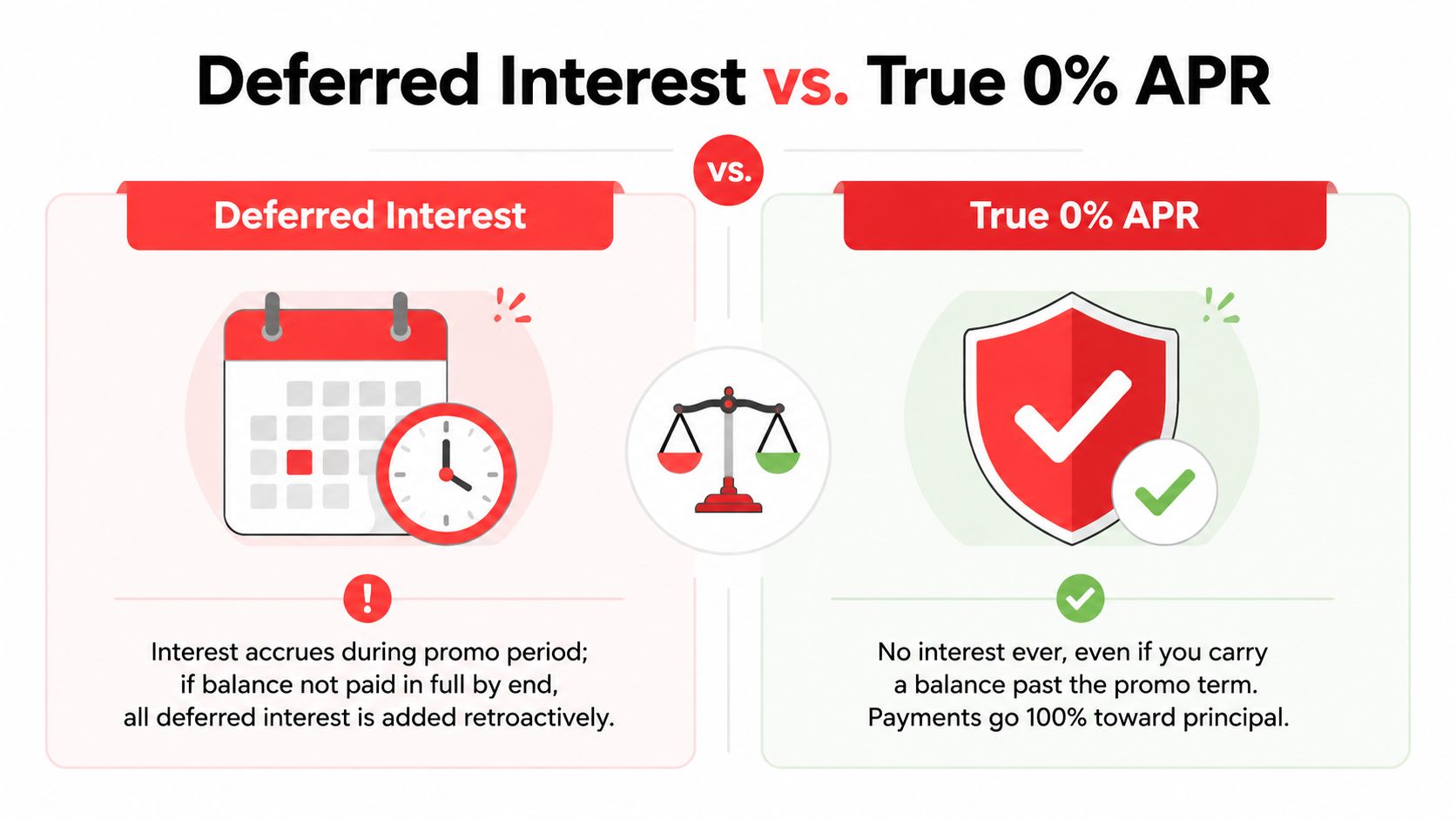
With deferred-interest financing, interest typically accrues from the first day. The lender waives that interest only if the entire balance is paid before the promotional deadline. If any balance remains when the promotion ends, accumulated interest can be charged retroactively on the original principal. Roof-financing guidance on promotional structures explains why that payoff threshold makes cash-flow timing critical.
A true 0% offer works differently. No interest accrues during the promotional period, and the balance converts to the standard APR after expiration. That structure still requires a repayment plan, but it doesn't create the same retroactive-interest cliff.
The payoff test
A homeowner considering deferred interest should divide the financed balance by the number of promotional months and then add a safety margin. Minimum payments are often designed to keep the account current, not to eliminate the balance before the deadline.
For example, a $20,000 roof at 24.99% deferred interest over 18 months, with $3,000 still outstanding at month 19, could trigger roughly $4,500 in back-interest charges. This is a supplied example of the risk, not a universal quote. The actual charge depends on the contract and account terms.
The decision rule is simple:
- Use deferred interest only when the payoff date is realistic. Expected insurance money, a documented bonus, or reliable cash reserves may support the plan.
- Choose true 0% when repayment timing is less certain. The borrower still needs to understand the post-promotion APR.
- Reject any offer that hides the regular terms. The contract should state the promotional end date, required payment, deferred amount, post-promotion APR, and payoff conditions.
Home-improvement financing disclosures show that “no payments” can mean payments are postponed while interest remains conditional. That distinction matters more than the headline offer.
The safest promotional plan is the one that still works if the insurance check, tax refund, or expected cash arrives late.
Bridging the Gap When Insurance Does Not Cover the Full Cost
A California homeowner can receive an insurance payment and still face a major bill before the crew can finish the roof. The insurer's calculation may separate actual cash value from recoverable depreciation, subtract the deductible, exclude certain line items, or treat code upgrades and betterment as the homeowner's responsibility.
A claim might pay $12,000 while the contractor's complete estimate reaches $22,000, leaving a $10,000 gap. Use that example to understand the planning issue, not to predict a claim result. The policy language and documented cause of loss control what insurance pays.
Mortgage and insurance rules can also affect the size of that shortfall. Some loan arrangements may accept actual cash value roof coverage, while replacement-cost coverage gives the homeowner a different path to recover covered repair costs. That makes the policy review part of the financing decision, not paperwork to handle later.
A safer five-step process
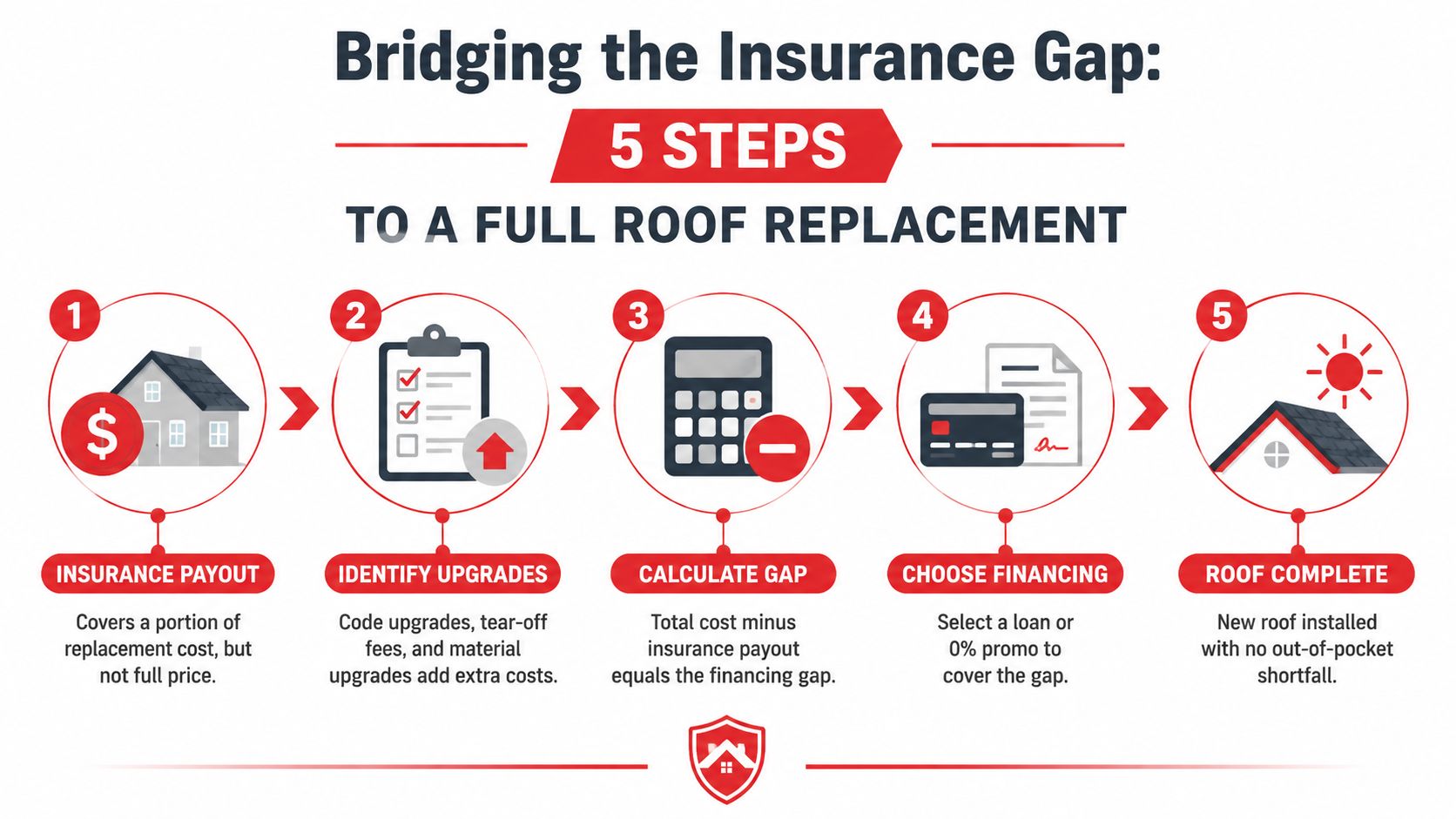
Obtain the claim documents. Collect the adjuster's estimate, payment explanation, deductible information, and depreciation schedule. Have the contractor check the scope for missing roofing work, but do not assume insurance will pay excluded items.
Separate required costs from choices. List code upgrades, tear-off, damaged decking, ventilation, and material changes as separate line items. This shows exactly which expenses insurance may exclude and which upgrades require separate funding.
Calculate the gap. Subtract confirmed insurance proceeds from the complete contract price. Keep recoverable depreciation separate until the insurer confirms the release requirements.
Finance only the shortfall. A fixed personal loan can suit a fast project without home equity. A home equity loan may fit a larger, planned gap when the borrower accepts the property-related risk. Contractor financing can work when the promotional terms are clear and the payoff schedule is realistic.
Coordinate disbursements. Confirm that funds arrive before the contractor's final invoice is due. If recoverable depreciation arrives later, apply it to the loan balance when the agreement permits instead of treating it as extra spending money.
For a policy-focused review, read this guide to whether homeowners insurance covers roof replacement in California. The policy, cause of loss, roof condition, deductible, and claim records determine the result.
The contractor agreement should state what happens if the insurer pays less than expected. Do not sign a payment schedule that depends on an unapproved supplement or uncertain reimbursement. Confirm the approved insurance amount, your cash contribution, and the financing amount before work begins.
California Energy Programs That Can Reduce Your Roofing Costs
A roof replacement can become more financially efficient when the scope includes qualified energy work. A standard replacement and an energy-performance upgrade aren't the same project, so the contractor should identify which costs are ordinary roofing and which may qualify for a program, rebate, or specialized loan.
California's GoGreen Home Energy Financing program, administered by the California Alternative Energy and Advanced Transportation Financing Authority within the State Treasurer's Office, uses credit enhancement to reduce lender risk. The program says that participating lenders may offer lower rates, longer payback terms, higher loan amounts, and approval to a broader base of borrowers for energy upgrades, as described on the official GoGreen Home Energy Financing page.
The state's Cool California program identifies cool roofs among energy-efficiency measures and directs applicants to the CoolCalifornia.org Funding Wizard and Energy Upgrade California for available grants, rebates, and incentives. Availability can vary by location and utility service area, including much of the PG&E and SCE territories, according to California's cool-roof funding information.
| Program Name | Type | Typical Savings | Best For |
|---|---|---|---|
| GoGreen Home Energy Financing | Credit-enhanced energy loan channel | Lower borrowing cost may be available through participating lenders | Homeowners bundling roofing with qualifying efficiency work |
| Cool California opportunities | Grants, incentives, and rebates | Varies by measure and eligibility | Cool-roof and related efficiency improvements |
| Utility efficiency programs | Rebates or incentives | Varies by utility and approved scope | Homeowners confirming service-area eligibility |
| PACE financing | Property-tax-linked assessment | Varies by project and contract | Energy-focused work where property-linked repayment is acceptable |
| USDA Section 504 | Government-backed rural assistance | Loans can reach $40,000 at 1% for qualifying rural homeowners | Eligible rural households meeting program rules |
| HUD Title I | Home-improvement loan | Loans can reach $25,000 | Homeowners needing a government-linked improvement option |
Some programs fund roof work only when it is bundled with qualifying improvements such as insulation, ventilation, or a cool-roof component. One current guide states that Mass Save 0% HEAT loans can cover roof work only when paired with qualifying improvements, and it also reports that the federal Section 25C energy-efficiency tax credit expired on December 31, 2025. Homeowners should verify current eligibility before relying on an older article or tax assumption, using the roof replacement financing and energy-upgrade guide as background.
PACE can simplify personal-credit qualification, but a property-linked obligation can complicate refinancing or a sale. Traditional financing is often cleaner when the project doesn't include qualifying energy improvements.
Contractor questions should include:
- Which materials qualify? Ask for manufacturer documentation and program references.
- What must be bundled? Confirm whether insulation, ventilation, or another efficiency measure is required.
- Who applies for the incentive? Clarify whether the homeowner, contractor, or lender submits paperwork.
- When is the money received? A future rebate shouldn't be counted as cash needed for the installation deposit.
How to Qualify and Prepare Your Financing Application
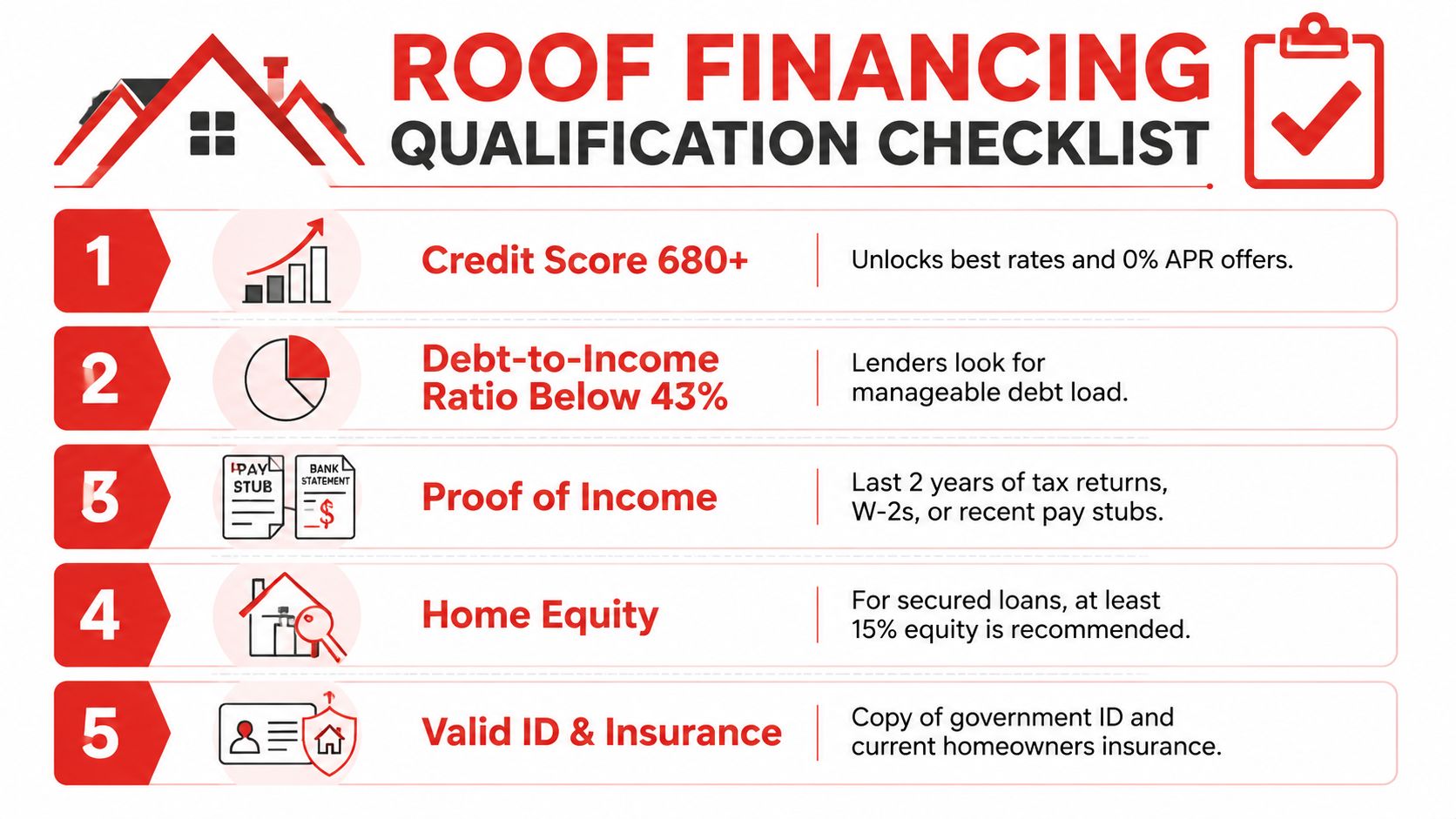
A roof loan gets easier to approve when the application matches the project cost. Start with a signed contractor estimate that separates materials, labor, tear-off, disposal, ventilation, decking allowances, warranties, and payment milestones. Include current insurance information so the lender and contractor can see whether an insurance payout leaves a remaining balance.
Credit is only one part of the review. A benchmark of 680 or higher may provide access to more competitive options, while borrowers below 640 may face fewer choices or higher costs. Lenders also examine debt-to-income ratio, income stability, open collections, recent bankruptcy, and available home equity. Correct errors and reduce high card balances before submitting a formal application when possible.
Build the file in the right order
Confirm the full project amount. Ask the contractor to identify the insurance-covered portion, your expected out-of-pocket gap, and any energy upgrades included in the scope.
Review credit reports and obligations. Check for reporting errors, collections, high balances, and recent applications before a hard inquiry.
Ask about prequalification. A soft-pull review can support rate shopping. Confirm exactly when the lender will perform a hard inquiry.
Gather income records. Prepare tax returns, W-2s, pay stubs, bank statements, and records for other income. Self-employed applicants should explain major income changes.
Compare written offers. Review APR, origination fees, late charges, prepayment terms, collateral, promotional conditions, and total repayment. Deferred interest requires special attention because missed payoff deadlines can change the cost sharply.
A contractor estimate is not financing approval. It establishes the project basis, while the borrower's income, debt, credit, and property determine eligibility.
California homeowners should also ask whether an energy-efficiency bundle changes qualification or available financing. Confirm which roofing materials or improvements qualify, what must be installed together, who submits documentation, and when any incentive arrives. Do not treat a future rebate as installation cash.
For a planned replacement, apply two to three weeks before the intended start date. That window allows time to compare offers and answer document requests. Emergency leaks demand faster decisions, but read the regular APR and payoff terms before authorizing work.
Example Payment Plans and Next Steps for Your Project
Payment examples help homeowners judge affordability, but they aren't quotes. APR, fees, credit profile, lender, term, and promotional eligibility can change the actual payment. The following table uses the project examples specified for planning, while the cited financing guidance confirms that personal-loan APRs may fall around 7% to 24% and contractor financing may range from 0% to 22% or more.
| Project Cost | Loan Term | APR | Monthly Payment | Total Interest Paid |
|---|---|---|---|---|
| $15,000 asphalt project | 60 months | 6.99% | Calculate from lender quote | Calculate from lender amortization |
| $15,000 asphalt project | 84 months | 8.99% | Calculate from lender quote | Calculate from lender amortization |
| $28,000 tile or metal project | 60 months | 8.99% | Calculate from lender quote | Calculate from lender amortization |
| $28,000 tile or metal project | 84 months | 11.99% | Calculate from lender quote | Calculate from lender amortization |
| $45,000 premium project | 120 months | 11.99% | Calculate from lender quote | Calculate from lender amortization |
| Qualifying promotional plan | Promotional term | Deferred interest or true 0% | Contract-specific | Depends on payoff timing and post-promotion terms |
The table intentionally avoids invented payment amounts. A lender's amortization schedule is the only reliable place to obtain the monthly payment and total interest for a specific borrower. Homeowners can use average roof replacement cost information to frame the project, then replace planning assumptions with the written estimate.
For a $28,000 project with a $12,000 insurance payout, the financing need would be $16,000, before considering deductibles, approved supplements, recoverable depreciation, or energy incentives. That is the important calculation. The homeowner shouldn't finance the insurance-funded portion because the loan application is convenient.
Energy rebates may reduce the financed principal when the project includes qualifying improvements, but the amount and timing must be verified before the loan is signed. A deferred-payment plan can preserve cash at the start, yet it still needs a payoff strategy that survives delays.
The next steps are practical: gather the insurance estimate, check the credit profile, obtain a written roof scope, and compare at least one outside loan with any contractor-arranged offer. California Roof Pros provides inspections, written findings, roof replacement planning, insurance-claim assistance, and financing options, including deferred-payment plans for up to 12 months, subject to lender terms.
California Roof Pros helps California homeowners turn an uncertain roof estimate into a defined scope, insurance-gap plan, and workable financing timeline. Visit California Roof Pros to request a roof inspection and discuss replacement financing with a licensed California roofing contractor serving Concord, the East Bay, and communities across the state.

The CA Roof Pros Editorial Team brings together roofing professionals and experienced content specialists dedicated to providing accurate, practical information about roofing, repairs, maintenance, and replacement. Every article is researched and reviewed to help California homeowners make informed decisions about their roofing needs.