A brown ring is spreading across the living-room ceiling after a winter storm. Or granules from an aging composition roof are collecting in the gutter, and every hard rain makes the homeowner wonder whether the next leak will reach insulation, drywall, or electrical wiring. In Concord and across the East Bay, that moment usually arrives before the homeowner has a budget, a contractor, or a clear answer to the most important question: does the roof need a repair, or is replacement the financially sound choice?
Residential roof replacement is a construction project, but it's also a capital decision with long-term consequences. Nearly 85% of residential roofing volume in the United States goes onto existing homes as full or partial replacement, rather than new construction, according to Home Innovation Research Labs' roofing replacement data. That means homeowners are usually managing aging materials, storm exposure, hidden deck damage, code requirements, permits, insurance, and financing at the same time.
A sound decision starts with an honest inspection and a complete project plan. The right recommendation may be to repair, monitor, or replace. The wrong recommendation is to patch a failing roof because replacement feels expensive today.
Table of Contents
- When a Roof Becomes a Replacement Decision
- Replace or Repair Reading the Real Cost Signals
- Choosing the Right Roofing Material for Your Home
- California Permits Codes and Energy Requirements
- How a Replacement Project Actually Runs
- Warranties Insurance and Financing in Plain Language
- Your Next Steps as a Homeowner
When a Roof Becomes a Replacement Decision
A Concord homeowner with a 22-year-old composition roof may notice granules in the gutters before seeing an obvious leak. Another may find a ceiling stain after a January storm, climb into the attic, and see daylight around a flashing detail. Neither symptom tells the whole story, but both deserve more than a tube of roof sealant.
A contractor evaluates the roof as a system. That means looking at shingle or tile condition, flashing, valleys, penetrations, underlayment, ventilation, decking, and the roof's repair history. Curling shingles, missing sections, exposed fasteners, rusting flashing, recurring stains, daylight in the attic, and soft decking all change the recommendation. Storm damage and rot matter especially when a repair would only postpone a broader failure.
Three practical condition buckets
A roof with isolated wear and a sound underlying assembly may still have useful runway. A small repair can make sense when the roof is relatively young, the damage is limited, and the surrounding materials remain flexible and intact.
A roof that has visible wear but no immediate systemic failure belongs in the monitor-closely category. It needs documented inspections, gutter and attic observations, and a replacement budget, not wishful thinking. A homeowner should know what conditions will trigger action, especially before the next period of heavy rain or wind.
Replacement becomes the responsible call when deterioration is widespread or the roof has suffered damage that repairs can't meaningfully extend. Repeated leak locations, broad granule loss, widespread curling, deteriorated flashing, structural rot, or storm damage across multiple roof planes usually point in that direction.
Practical rule: If the same roof area needs repeated attention, the question isn't whether another patch is possible. The question is whether the patch protects the home long enough to justify its cost.
The financial context is substantial. Verisk reported that the average residential roof replacement cost reached $17,631 in 2025, while the total residential roof replacement cost value reached $23 billion that year, as detailed in its roofing risk and replacement cost report. Homeowners considering renovation financing may also benefit from understanding how property projects are evaluated in resources such as fixer upper investor loans, particularly when roof work is part of a larger purchase or improvement plan.
Replace or Repair Reading the Real Cost Signals
The repair-versus-replacement decision shouldn't be driven by the lowest invoice. It should be driven by the amount of useful roof life that the work buys and the risk it leaves behind.
A small, isolated defect on a younger roof can justify a repair. The repair should address the failed flashing, shingle, seal, or penetration and include a check of the surrounding area. If the assembly remains sound, a limited intervention can preserve the roof without creating unnecessary expense.
The calculation changes when leak calls recur. Verisk placed average residential roof repair costs at $4,699 in 2025, with repair costs rising about 25% against the 2021 through 2024 average, according to its residential roofing cost analysis. That doesn't mean every repair costs that amount. It does show why repeated roof-related losses deserve serious financial scrutiny.
The three decision tiers
- Isolated damage: A limited failure on a roof with substantial remaining serviceability generally supports repair. The contractor should identify the exact failure and explain why adjacent materials don't require replacement.
- Recurring deterioration: Repeated leak calls, expanding wear, and widespread granule loss suggest that repairs are buying less protection each time. A sequence of repairs can become more expensive than planning a controlled replacement.
- Systemic failure: Age-related breakdown, widespread storm impact, moisture damage, or compromised decking means patching may only transfer the cost into interior repairs and emergency service.
| Roof Condition | Typical Cost Range | Recommended Action |
|---|---|---|
| Isolated damage on a sound assembly | Repair cost varies by access, material, and damage location | Repair and document the work |
| Repeated leaks or broad surface wear | Repair costs can accumulate quickly | Compare repair history with a replacement estimate |
| Widespread failure or structural moisture damage | Replacement is a major project cost | Replace the roof system and correct underlying causes |
A practical rule is simple: if a repair addresses one defect but the inspection identifies several independent failure patterns, request a replacement estimate before authorizing the patch. Homeowners can also review a clear explanation of exterior maintenance considerations in the South Mountain Window Cleaning roof cleaning guide, then compare repair scope with the guidance in this California shingle repair guide.
The common mistake is repairing a roof that has only a short useful window left. That choice can make sense when the repair buys meaningful time. It is poor planning when the same roof will require tear-off, disposal, underlayment, and replacement shortly afterward.
Choosing the Right Roofing Material for Your Home
Material selection should follow the homeowner's priorities, not the other way around. Asphalt composition shingles usually win on initial value and broad availability. Standing seam metal costs more at the outset but can serve a long-term ownership plan. Concrete and clay tile offer durability and a distinctive appearance, while wood shake or alternative products require close attention to fire rules and local suitability.
Asphalt composition shingles
Asphalt is the default for many Concord and East Bay homes because it fits common roof designs, weighs less than tile, and offers a broad range of colors and profiles. Its trade-off is service life. It generally makes more sense for homeowners prioritizing initial budget, straightforward installation, and familiar repairability than for owners seeking the longest possible replacement interval.
The roof still needs more than shingles. Underlayment, flashing, ventilation, edge metal, and correct fastening determine whether the installed system performs as intended. A comparison of system characteristics is available in this guide to metal roofing versus asphalt shingles.
Metal roofing
Standing seam metal is the long-horizon option. Properly installed metal roofing can last 40 to 70 years, according to the roofing cost research supplied for this guide. It costs more upfront, requires careful detailing around penetrations and transitions, and must be installed by a crew familiar with thermal movement and concealed fastening.
Metal can suit a homeowner planning to remain in the property for many years. It also offers a clean architectural appearance, but the final choice should account for roof geometry, surrounding materials, noise expectations, and the project's budget.
Concrete and clay tile
Tile can provide a durable, distinctive roof covering, but its weight makes structural verification essential. The contractor should confirm that rafters, trusses, decking, and support conditions can carry the selected assembly, especially when replacing a lighter roof with tile.
Tile also demands careful attention to underlayment and flashing. Cracked or displaced units may be repairable, but underlayment failure beneath an older tile roof can make a full system renewal more practical than surface replacement alone.
Wood shake and alternatives
Wood shake has strong curb appeal but faces significant limitations in higher fire-severity areas. A homeowner shouldn't choose it until the local jurisdiction, wildfire designation, assembly rating, and insurance implications have been checked.
| Material | Cost per Sq Ft Installed | Expected Lifespan | California Code Notes |
|---|---|---|---|
| Asphalt composition | Varies by profile, roof complexity, and labor | Shorter than metal or tile | Must be installed as a code-compliant assembly |
| Standing seam metal | Higher upfront investment | 40 to 70 years | Confirm assembly details, flashing, and local requirements |
| Concrete or clay tile | Higher structural and installation demands | Long service potential | Structural verification is essential |
| Wood shake or alternative | Varies substantially by product | Depends on product and exposure | Fire-zone restrictions and assembly ratings may control |
The right material is the one that balances budget, longevity, fire performance, weight, and appearance. Product brochures can't answer that question without an inspection of the home beneath them.
California Permits Codes and Energy Requirements
California roof work is governed by more than the visible covering. Permit rules vary by jurisdiction, and the trigger may be roof area, structural work, decking replacement, or the scope of renewal. A homeowner should never assume that a contractor's statement about permits applies throughout the state.
In one San Diego code example, a permit is required when roof renewal alters or replaces framing, sheathing, support elements, lateral-resisting components, or the foundation system. That same local guidance allows limited in-kind decking repair without a permit for certain single-family homes, duplexes, and townhouses when the cumulative replaced sheathing area doesn't exceed 25% of the entire roof surface area, as described in the municipal roof renewal bulletin.
What the assembly must include
For asphalt shingles, 2018 IRC-based guidance calls for underlayment meeting ASTM D226 Type I or ASTM D4869 Type I. The guidance specifies one layer on slopes of 4:12 and greater, and two layers on slopes from 2:12 to 4:12, according to this roofing code guide.
Attic ventilation also has a measurable code role. Enclosed attics require cross ventilation with a minimum net free ventilating area of 1/150 of attic floor area. That can reduce to 1/300 only when balanced intake and exhaust conditions or a vapor retarder are present, as explained in this attic ventilation guidance. Poor ventilation can contribute to heat, condensation, moisture accumulation, and ice dams.
| Requirement | Trigger | What It Demands |
|---|---|---|
| Permit review | Structural alteration, qualifying re-roof work, or local area threshold | Confirm scope with the local building department |
| Underlayment | Asphalt shingle installation | Use the required material and layer arrangement |
| Attic ventilation | Enclosed attic | Provide compliant intake and exhaust ventilation |
| Wildfire protection | Designated wildfire-prone areas | Use a compliant Class A roof assembly and compatible details |
| Energy requirements | Jurisdictional roof replacement rules | Confirm applicable reflectance and energy provisions |
| Inspection closeout | Permitted work | Keep the final inspection record and approved documentation |
California wildfire areas may require Class A roof coverings. The rating applies to the complete roof assembly tested under ASTM E108 or UL 790, not merely the outer shingle or tile layer, according to this California fire-safety code summary. Local handouts can also set roof-area thresholds, including one example requiring a permit for replacement or repair exceeding 300 square feet of roofing material, as shown in this California re-roof handout.
Before work starts, the contractor should confirm the permit path, HOA material rules, wildfire requirements, energy provisions, bathroom and kitchen vent terminations, flashing, drip edge, and nailing pattern. A California municipal guide also confirms that some roof replacements must meet energy specifications as part of the permit process, not as an optional upgrade, as outlined in this residential roofing permit guide.
How a Replacement Project Actually Runs
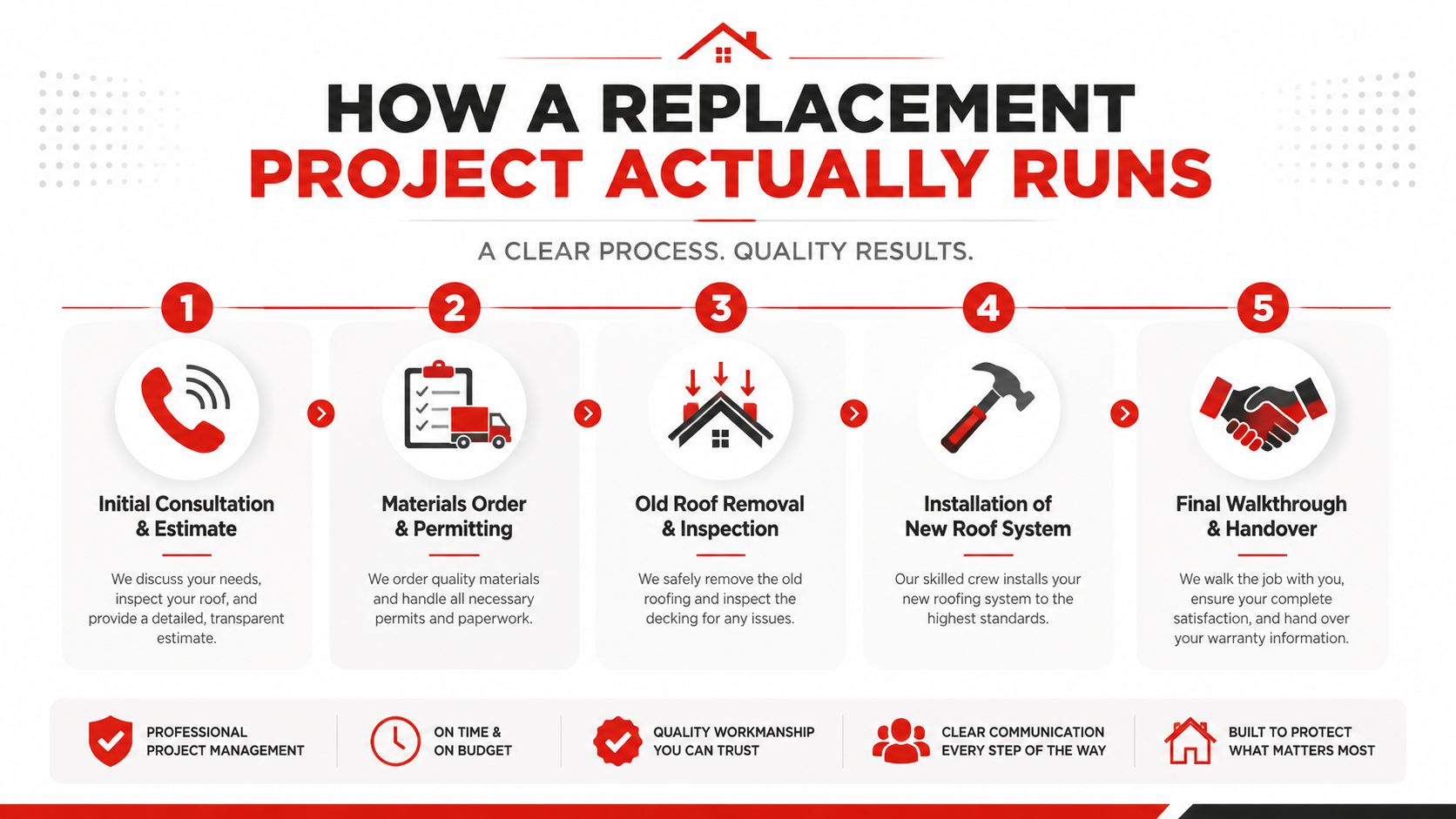
A well-managed replacement begins before materials arrive. The contractor inspects the exterior and attic, traces active leaks, checks flashing and ventilation, and identifies areas where the decking may be compromised. Those findings should become a line-item estimate that separates roofing materials, tear-off, disposal, carpentry, code upgrades, ventilation, and possible change-order work.
The project sequence
- Inspection and estimate: The contractor documents roof planes, penetrations, attic conditions, ventilation, flashing, and visible damage. Photos and clearly separated scope items make competing bids easier to evaluate.
- Planning and permitting: The team confirms the permit, orders materials, schedules the dumpster, establishes staging areas, and communicates with the homeowner about access, noise, vehicles, landscaping, and neighbor considerations.
- Tear-off and deck inspection: Crews remove the existing covering and inspect the exposed deck. Rot or moisture damage discovered at this stage should be photographed and priced through a defined change-order process.
- Installation: The crew installs the roof system, including underlayment, flashing, edge details, ventilation components, and the selected covering. A project manager and foreman should monitor safety, workmanship, and daily cleanup.
- Walkthrough and handover: The homeowner receives the final inspection documentation, warranty information, completion photos, and paperwork confirming the project closeout.
For a typical 2,000-square-foot Concord home, the active installation may take one to three working days, with additional buffer for weather or plywood rot. That project-management discipline is easier to maintain when the estimate clearly records quantities, assemblies, allowances, and exclusions. Estimating platforms such as Exayard roofing estimating software illustrate the value of organized scope development, but the homeowner still needs a field inspection and a written contract.
Financing should be discussed before tear-off, not after an unexpected deck issue appears. If insurance may apply, the contractor should document storm-related damage without promising claim approval, and any supplemental request should match photographs, measurements, and the policy's requirements. At completion, the homeowner should receive lien waivers, warranty registration details, the final inspection card, and records of approved change orders.
Warranties Insurance and Financing in Plain Language
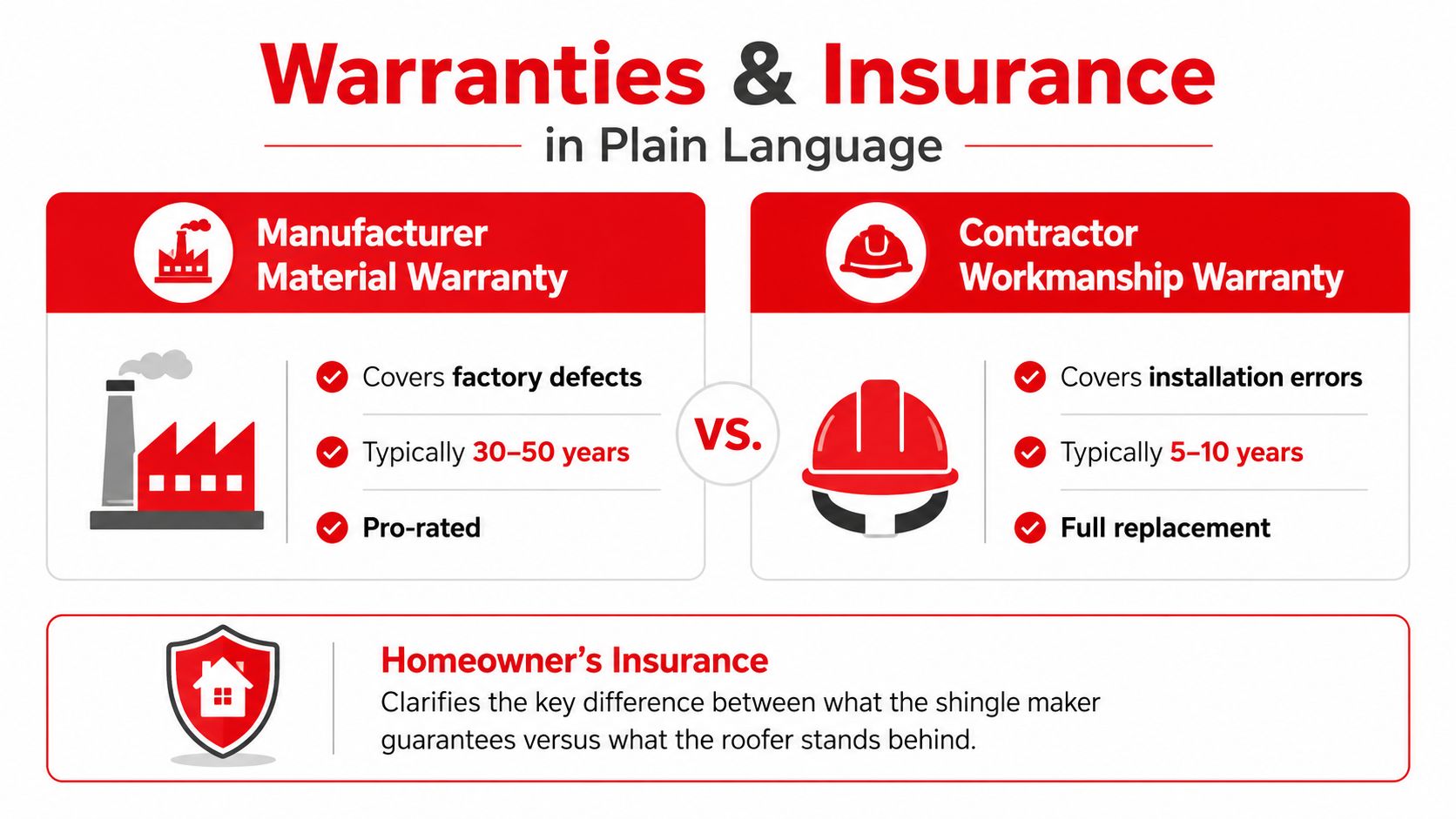
A roof warranty has two separate authors. The manufacturer warranty addresses defects in the roofing material. The contractor workmanship warranty addresses installation errors. Homeowners who treat those documents as interchangeable often discover the difference only after a failure.
Manufacturer material warranties commonly describe coverage lasting 30 to 50 years, often on a pro-rated basis, according to the supplied industry research. Workmanship coverage commonly runs five to ten years and addresses installation-related problems. Those ranges aren't promises for every product or contractor, so the actual written terms matter more than the headline duration.
Questions to answer before signing
- Coverage: Which defects fall under the material warranty, and which installation failures fall under workmanship coverage?
- Backing: Who handles labor if the installing contractor stops operating?
- System scope: Are flashing, underlayment, ice-and-water protection, ventilation, and edge details included?
- Transfer: Can the warranty transfer to a future buyer, and does transfer reduce coverage?
- Exclusions: What maintenance, storm events, improper ventilation, or alterations can void coverage?
Insurance follows a different logic. Homeowners policies commonly address sudden, accidental events such as wind, hail, or a fallen tree, while ordinary aging, wear, and deferred maintenance are typically excluded. Verisk reported that non-recoverable depreciation approached 20% of total roof claims in 2025, compared with 16% in 2021, a distinction discussed in this insurance analysis of roof claim severity.
The homeowner should keep dated inspection photos, repair invoices, storm documentation, adjuster correspondence, and the policy declarations page. A denied claim doesn't automatically prove that no damage exists, but an appeal needs evidence tied to the policy language. This California roof insurance guide can help homeowners frame the initial questions.
Financing may involve a contractor payment plan, a home-equity line, or FHA Title I financing. The important terms are the annual percentage rate, promotional expiration, origination charges, prepayment conditions, payment schedule, and whether the financing covers approved change orders. A roof decision should remain financially workable after the promotional period ends.
Your Next Steps as a Homeowner
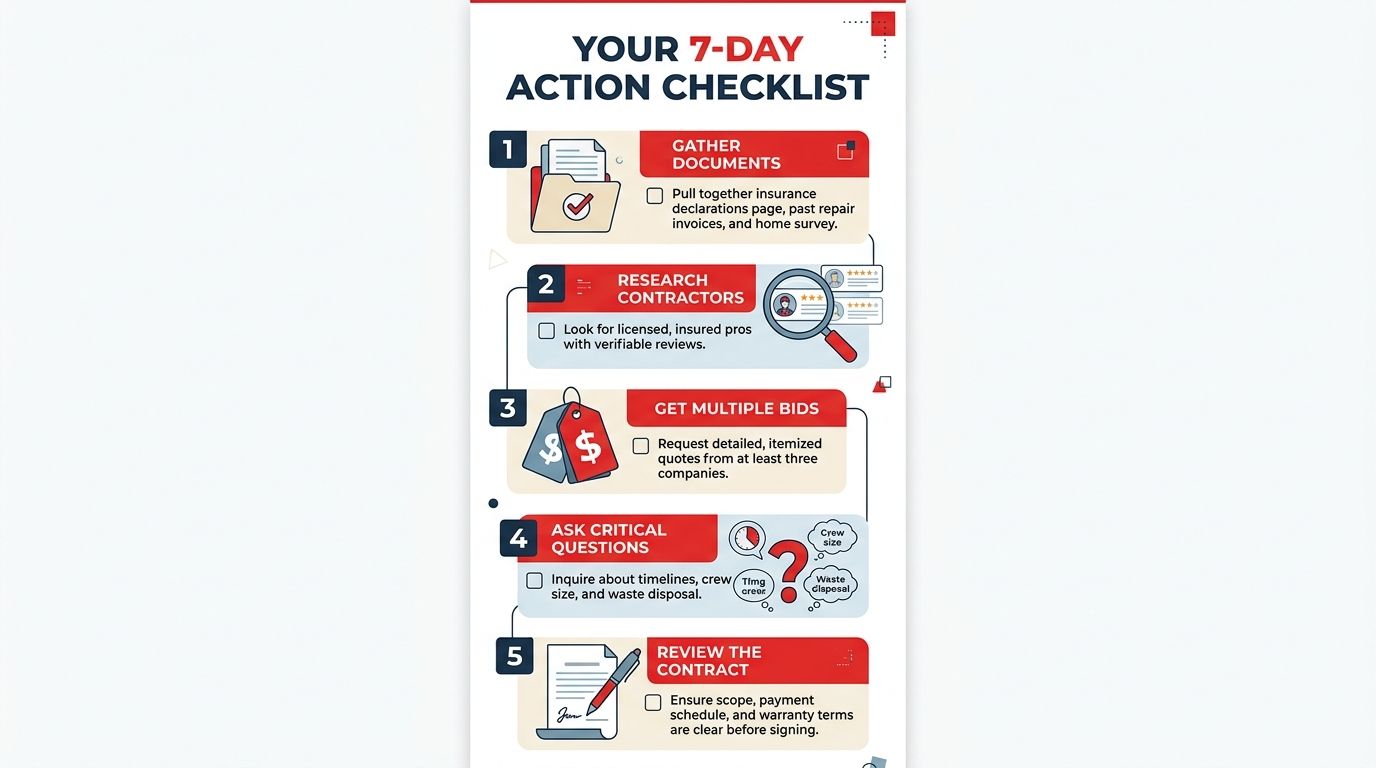
A homeowner doesn't need to commit to replacement after the first inspection. The immediate objective is to assemble the facts, obtain a clear scope, and compare recommendations that use the same assumptions.
Gather the roof file
Pull together the insurance declarations page, prior repair invoices, the home's square footage, and the year the current roof was installed. Add photos of ceiling stains, attic moisture, fallen shingles, gutter granules, and any storm event that may have affected the property.
Screen the estimate
A credible estimate should identify the roof covering, tear-off, disposal, underlayment, flashing, ventilation, decking allowance, permits, cleanup, and warranty terms separately. A single lump sum that combines tear-off, disposal, and underlayment prevents a homeowner from seeing what the contractor is proposing.
Use the inspection visit to ask direct questions:
- Licensing: What is the contractor's California license number, and is the CSLB standing current?
- Insurance: Can the contractor provide proof of liability and workers' compensation coverage?
- Certification: Does the contractor hold the material manufacturer's required certification for the proposed warranty?
- Crew: Are the installers employees or subcontractors, and who supervises the work?
- Change orders: How will hidden decking damage be photographed, priced, and approved?
- Closeout: Which inspection card, lien waivers, warranty documents, and completion photos will arrive at handover?
The homeowner should obtain a second opinion before signing, especially when one inspection recommends immediate replacement and another recommends monitoring. A reputable contractor won't demand a same-day signature or use an unexplained deadline to force the decision.
California Roof Pros provides roof inspections, written findings, repairs, full residential roof replacement, project scheduling, financing options, and insurance claim assistance for homeowners in Concord and the broader East Bay. The practical first move is to schedule a free roof inspection, collect the written findings, and decide from documented conditions rather than pressure.
California Roof Pros can inspect the roof, document visible and attic conditions, explain whether repair or replacement makes financial sense, and prepare a written scope for the work. Visit California Roof Pros to schedule a free inspection and start the conversation with a Concord-based roofing contractor serving homeowners across California.

The CA Roof Pros Editorial Team brings together roofing professionals and experienced content specialists dedicated to providing accurate, practical information about roofing, repairs, maintenance, and replacement. Every article is researched and reviewed to help California homeowners make informed decisions about their roofing needs.