
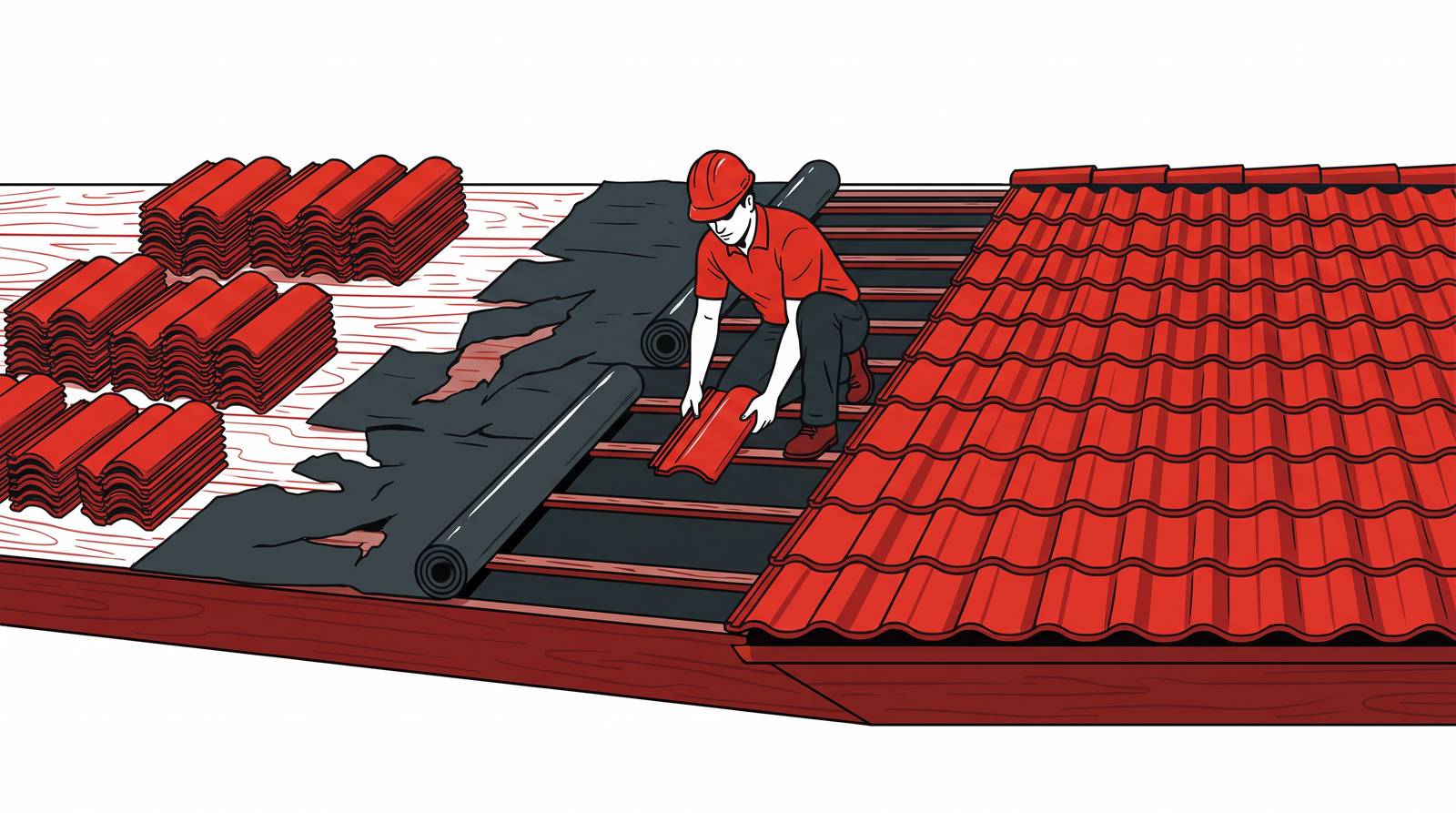
Replacing the underlayment on a tile roof usually costs $300–$500 per square (100 sq ft) nationally, and more in the Bay Area. Expect roughly $500–$1,200 per square, or about $12,000–$28,000 for a typical 2,000–2,500 sq ft tile roof, including some replacement tiles. The job is called a lift and relay: the existing tiles are removed and stacked, the worn underlayment is replaced, and the same tiles are reinstalled. It usually costs less than a new tile roof because you keep the tile.
Concrete and clay tile can last 50 years or more, but the underlayment beneath it, which is the real waterproofing layer, often wears out in 20–30 years. That’s why so many 1990s and 2000s tile roofs in the East Bay, Tri-Valley and South Bay start leaking even though the tiles look fine.
Tile roof leaking? Call (925) 412-4584. We find the source, show you photos of the underlayment, and tell you whether a targeted roof repair or a lift and relay makes sense. California Roof Pros · CSLB #1158153 · Concord & Danville, CA
How much does it cost to replace underlayment on a tile roof?
| Item | Typical range | Notes |
|---|---|---|
| Lift and relay, national average | $3–$5 per sq ft ($300–$500 per square) | About $6,000–$10,000 for 2,000 sq ft (Fixr) |
| Lift and relay, Bay Area / Sacramento estimate | $5–$12 per sq ft ($500–$1,200 per square) | Higher labor costs, permits, steep or complex roofs, two-story access |
| Typical 2,000–2,500 sq ft tile roof (NorCal) | About $12,000–$28,000 | Includes new flashings and an allowance for broken tile |
| Replacement tiles | Often around 10% of tiles | More on older or brittle clay. Matching tile drives the price |
| Decking repair | Priced per sheet | Only known once the old underlayment is off |
| New tile roof instead | Higher | See our clay tile cost guide |
National figures from Fixr (2025). The Bay Area range is our estimate for planning only. Your exact price depends on roof size, pitch, tile type and breakage, deck condition and permit fees, and your written inspection quote is the real number.
What drives the price
- Tile type and breakage. Concrete tile is heavier and tougher. Older clay tile is more brittle and breaks more when lifted, especially at nail holes.
- Matching tile. If your tile profile or color is discontinued, replacements can be salvage stock or a near match, which adds cost.
- Underlayment choice. Upgraded synthetic or self-adhered underlayments cost more than felt but are built to outlast it.
- Battens, flashings and vents. Rusted or damaged flashings must be replaced, not reused. Battens are added or replaced where needed.
- Roof pitch and access. Steep, cut-up or two-story roofs take longer and need more staging.
Why tile roofs leak when the tiles look fine
Tile is a water-shedding layer, not a waterproof one. Wind-driven rain gets under tiles, and the underlayment carries it down to the eaves. The Tile Roofing Industry Alliance installation manual describes tile as a water-shedding assembly over an underlayment that does the waterproofing.
Many California tile roofs installed in the 1980s–2000s used a single layer of 30-lb felt. After decades of attic heat and the sun reaching it through gaps, felt dries out, cracks and tears. The tiles keep looking good from the street while the layer under them fails.
Signs your tile roof underlayment needs replacing
- Leaks or ceiling stains while the tiles look intact, especially after the first big storms of the rainy season.
- Brittle, cracked or crumbling felt visible at the eaves, under a lifted tile, or from the attic.
- The roof is 20–30 years old and you’re paying for repeat leak repairs.
- Daylight or water stains on attic sheathing, or soft spots in the deck.
- Rusted valley or wall flashings, which usually wear out alongside the underlayment.
If water is coming in right now, follow our roof leak checklist first. A single leak at a pipe or wall is often a flashing repair, not a full lift and relay. A roof inspection with photos tells you which you need.
How a lift and relay works
- Inspection and permit. We check tile condition, breakage risk and replacement-tile availability, then pull the re-roof permit.
- Lift. Tiles are removed by hand and stacked safely, with damaged tiles set aside.
- Tear-off. The old underlayment, worn flashings and rotted battens are removed down to the deck.
- Deck repair. Damaged sheathing is replaced. Tile requires solid sheathing under California code.
- New underlayment and flashings. The underlayment goes on to code, along with new valley, wall and penetration flashings, and battens where used. Many cities inspect at this stage.
- Relay. The original tiles are reinstalled and fastened, broken ones are replaced, and hips and ridges are finished.
- Final inspection and cleanup.
A typical 2,000–2,500 sq ft home takes about one to two weeks of working days, depending on the weather and how cut up the roof is. In the rainy season, each section should be dried in before the end of the day.
California code and permit points
- Underlayment rules. The California Residential Code (Section R905.3) requires tile to sit on solid sheathing at a minimum 2.5:12 slope. On slopes from 2.5:12 up to 4:12 it needs two layers of underlayment or one self-adhered layer, and above 4:12 one layer lapped shingle-fashion, using approved products such as ASTM D226 Type II felt or a D1970 self-adhered membrane.
- Reusing tile. Existing clay or concrete tile may be reinstalled, but cracked or broken tiles may not.
- Permits. Re-roofing needs a building permit in most Bay Area and Sacramento cities (BayREN permit guide). Expect an inspection with the underlayment and flashings in place, then a final.
- Title 24 cool roof. When more than 50% of a steep-slope roof is replaced in certain climate zones (in our area, zone 12 covers much of Contra Costa, Alameda, Solano and Sacramento counties, and zone 4 parts of Santa Clara County), the new roofing must meet cool-roof reflectance rules unless an exception applies. Whether relaying existing tile triggers this varies by building department, so we confirm it at permit time.
- Fire zones. Clay and concrete tile are Class A fire-rated. In high-fire-hazard areas, local rules may also call for bird stops at the eaves and a cap sheet or other protection under profiled tile.
Lift and relay vs. a new tile roof
| Lift and relay makes sense when… | New tile (or a new roof) makes sense when… |
|---|---|
| Tiles are sound concrete or clay with little cracking | Many tiles are cracked, spalled or brittle |
| Your profile and color are still available for replacements | The tile is discontinued and nothing interlocks with it |
| You like the look and want to keep it | You want a new look or a lighter roof |
| The structure and deck are in good shape | The deck needs widespread replacement |
| Budget matters most | You want a new manufacturer warranty on the tile |
The Tile Roofing Industry Alliance notes that if no available tile interlocks with your existing tile, a full replacement may be the only option. If you’re weighing a new roof, see our roof replacement service.
Tile roofs in Los Gatos, Pleasanton and the Bay Area
We see a lot of aging tile underlayment in the Tri-Valley and South Bay. In Pleasanton, Dublin and San Ramon, many 1990s concrete-tile subdivisions are now at the age where the original felt fails, and HOAs often require the same tile look, which is a good fit for lift and relay. In Los Gatos and the foothills, clay tile, steep pitches and wildfire zones mean careful handling, extra replacement stock and fire-zone details at the eaves.
Tile roof underlayment FAQ
How much does it cost to replace underlayment on a tile roof?
Nationally, about $3–$5 per square foot ($300–$500 per square). In the Bay Area and Sacramento region, plan on roughly $5–$12 per square foot, or about $12,000–$28,000 for a typical 2,000–2,500 sq ft tile roof including replacement tiles. An inspection gives you an exact quote.
Can you replace underlayment without replacing the tiles?
Yes. That’s a lift and relay: the tiles are removed and stacked, the underlayment and flashings are replaced, and the same tiles are reinstalled. Cracked or broken tiles must be replaced with matching ones.
How long does underlayment last under a tile roof?
Older felt underlayment often lasts about 20–30 years, while the tile itself can last 50 years or more. Modern synthetic and self-adhered underlayments are designed to last longer than felt.
Do I need a permit to replace tile roof underlayment in California?
In most Bay Area and Sacramento cities, yes. A lift and relay is a re-roof, which needs a building permit and inspections, usually one with the new underlayment and flashings in place and a final.
Is lift and relay cheaper than a new tile roof?
Usually, because you reuse the tile. The labor is similar, so the savings come mainly from materials. If many tiles are broken or your tile is discontinued, a new roof can be the better value.
Find out what’s under your tiles.
California Roof Pros inspects tile roofs, photographs the underlayment, and gives you a written, line-item quote for a repair, a lift and relay, or a new roof. Permits and inspections are handled. We serve the East Bay, Tri-Valley, South Bay, San Francisco, the Peninsula, North Bay and Greater Sacramento from Concord and Danville. Call (925) 412-4584 or book a tile roof repair inspection.
California Roof Pros · 5650 Imhoff Drive, Suite A, Concord, CA 94520 · CSLB #1158153

The CA Roof Pros Editorial Team brings together roofing professionals and experienced content specialists dedicated to providing accurate, practical information about roofing, repairs, maintenance, and replacement. Every article is researched and reviewed to help California homeowners make informed decisions about their roofing needs.