To choose a roofer in California, confirm an active C-39 (Roofing) license on the CSLB website, check that workers’ compensation and a bond are on file, get two or three written, line-item quotes for the same scope, and sign a contract that limits the down payment to 10% or $1,000, whichever is less. Then pay only as the work is completed, and make sure the job is permitted and passes final inspection.
Those few checks rule out most bad outcomes: unlicensed crews, surprise change orders, and roofs that fail inspection or void a manufacturer warranty. This guide walks through each one, with the California rules behind them.
Comparing roofing quotes? Get a free inspection and a written, line-item quote you can hold side by side with others. Call (925) 412-4584 or see our roof replacement service. California Roof Pros · CSLB #1158153 (C-39) · Concord & Danville, CA
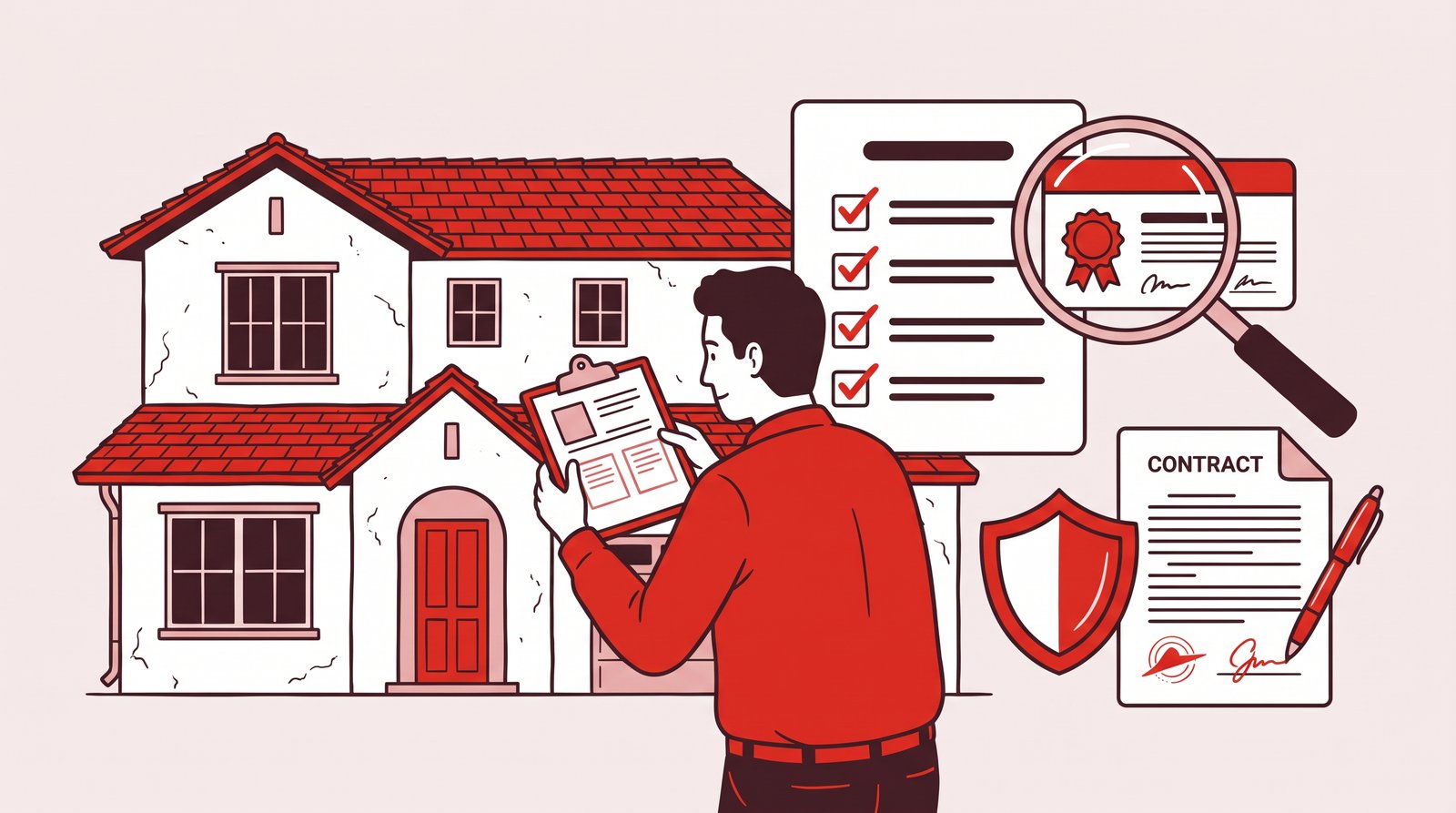
The 12-point checklist
| # | Check | What good looks like |
|---|---|---|
| 1 | License | Active CSLB license with the C-39 Roofing classification (or a B General license for a larger remodel) |
| 2 | Workers’ compensation | Policy on file with CSLB. Roofing (C-39) contractors are required to carry it |
| 3 | Bond and discipline | Bond on file, no unresolved complaints or disciplinary actions on the license page |
| 4 | Liability insurance | A current certificate naming the business on the license |
| 5 | Local presence | A real office address and a phone that a person answers |
| 6 | Manufacturer status | A certification you can verify on the manufacturer’s own site |
| 7 | Inspection | Someone gets on the roof (or in the attic) and gives you photos |
| 8 | Written, line-item quote | Tear-off, underlayment, flashing, ventilation, decking allowance, permit and disposal each listed |
| 9 | Permit | The contractor pulls it and the price includes it |
| 10 | Down payment | No more than 10% of the contract price or $1,000, whichever is less |
| 11 | Payment schedule | Payments never run ahead of the work completed |
| 12 | Warranty | Workmanship and manufacturer warranties in writing, with the length stated |
1. Verify the license on CSLB, not on the truck
Every roofing job in California that costs $1,000 or more in labor and materials needs a licensed contractor, and so does any smaller job that needs a building permit or hired workers. The Contractors State License Board raised that “minor work” threshold from $500 to $1,000 on January 1, 2025. A re-roof is always over the line.
Ask for the license number, then look it up yourself with CSLB’s license check or by calling 800-321-CSLB (2752). On the license page, confirm:
- Status is active and the business name matches the name on your quote.
- The classification is C-39 (Roofing), or B (General Building) if the roof is part of a larger remodel.
- Workers’ compensation is on file. CSLB states that C-39 roofing contractors are already required to carry it (CSLB industry bulletin). If a worker is injured on an uninsured job, you could be exposed.
- A bond is on file, and there are no pending or past disciplinary actions you don’t understand.
Our own license, CSLB #1158153, is linked so you can check it the same way.
2. Check insurance and who will actually be on your roof
Ask for a certificate of general liability insurance and who the crew will be. Some companies sell the job and hand it to a subcontractor you never vetted. That isn’t always a problem, but you should know, and the subcontractor needs its own license and workers’ comp. California Roof Pros uses its own trained crews on every job.
3. Look for verifiable manufacturer credentials
Shingle and tile manufacturers certify roofers who meet their training and installation standards, and the top tiers unlock longer system warranties. Don’t take a logo on a website at face value: look the company up on the manufacturer’s own contractor directory. For example, GAF lists its Master Elite® contractors on gaf.com. Installing a system the way the manufacturer specifies is also what keeps its warranty valid.
4. Get two or three quotes for the same scope
The cheapest quote is often the one that leaves things out. Ask every roofer to price the same scope, in writing, line by line:
- Tear-off of existing layers and disposal
- Decking inspection and a per-sheet price for replacing damaged plywood
- Underlayment type (felt, synthetic or self-adhered at valleys and eaves)
- New flashing at walls, chimneys, skylights and pipes, not reused flashing
- Ventilation (ridge and eave vents) and drip edge
- The roofing product by brand and line, and its fire rating
- Permit, inspection and any Title 24 cool-roof requirements
- Cleanup, magnetic nail sweep and the start and finish dates
Typical Northern California price ranges are in our roof replacement cost guide. If one quote is far below the others, find out which line is missing.
5. Questions to ask a roofer before you hire
- What is your license number, and is the C-39 classification on it?
- Who will do the work: your own crew or a subcontractor?
- Will you pull the permit, and is it included in this price?
- What is under my shingles or tiles right now, and what will you replace?
- How do you price rotted decking you find after tear-off?
- How long is your workmanship warranty, and what does the manufacturer’s warranty cover?
- How will you protect my landscaping, gutters and driveway?
- What happens if it rains mid-job? (In the Bay Area rainy season, a roof should never be left open overnight without protection.)
- Can I talk to two homeowners you worked for in my area this year?
6. Know the California contract and payment rules
California home improvement contracts come with consumer protections. CSLB’s homeowner checklist and consumer guide spell them out:
- Down payment: no more than 10% of the contract price or $1,000, whichever is less. Avoid paying in cash.
- Progress payments: pay only as work is completed. Payments should not exceed the value of the work done or materials delivered.
- Right to cancel: you generally have three business days to cancel a home improvement contract, or five business days if you’re 65 or older. Don’t let a contractor start work or pull permits during that window, and don’t waive it under pressure.
- Everything in writing: start and finish dates, a detailed description of work and materials, whether permits are included, and that any change must be a written change order.
- Door-to-door sales: a home improvement salesperson who comes to your door must be registered with CSLB. Ask to see the registration card.
7. Red flags
- A large deposit up front, or a request for cash.
- “Storm chasers” knocking after a windstorm with out-of-area plates and no local office.
- Offers to “skip the permit” to save money. Unpermitted roofs can cause problems with insurance claims and when you sell the house, where a roof certification may be requested.
- A quote with one lump-sum number and no scope.
- Pressure to sign today for a “special price”.
- Promises to cover your insurance deductible. That’s not a legitimate discount.
8. After you sign: permit, inspection and paperwork
Most Bay Area and Sacramento cities require a building permit for a re-roof, with a final inspection. In some climate zones, replacing more than half the roof also triggers Title 24 cool-roof rules. Keep a folder with the contract, change orders, permit card and final sign-off, product invoices, and both warranties. Make the last payment after the final inspection passes and the site is clean.
Hiring a roofer in Danville, Oakland and the East Bay
Local knowledge matters. In Danville and the Tri-Valley, many homes have concrete tile, HOA color rules and hillside wildfire zones that call for Class A assemblies. In Oakland, older homes often hide two or three layers of roofing and tired decking that only show up at tear-off, so a clear per-sheet decking price protects your budget. A roofer who works these neighborhoods every week will quote for them up front.
Choosing a roofer FAQ
How do I check if a roofer is licensed in California?
Search the contractor’s name or license number on the CSLB website’s license check, or call 800-321-CSLB (2752). The license should be active and list the C-39 Roofing classification (or B General Building), with workers’ compensation and a bond on file.
How much should I pay a roofer up front in California?
No more than 10% of the contract price or $1,000, whichever is less. After that, pay only as the work is completed, so payments never get ahead of the work or materials delivered.
Do roofers in California need workers’ compensation?
Yes. CSLB states that C-39 roofing contractors are required to carry workers’ compensation insurance. You can confirm the policy on the contractor’s CSLB license page.
Can I cancel a roofing contract in California?
For most home improvement contracts, you have three business days to cancel, or five business days if you are 65 or older. Don’t let the contractor start work or pull permits during that period.
How many roofing quotes should I get?
Two or three, for the same written scope. Compare line items such as tear-off, decking, underlayment, flashing, ventilation and the permit, not just the total price.
Put us on your shortlist.
California Roof Pros is a licensed C-39 roofing contractor (CSLB #1158153) and GAF Master Elite® certified. Our own crews do the work, you get a written, line-item quote, and we handle permits and inspections across the East Bay, San Francisco, the Peninsula, South Bay, North Bay and Greater Sacramento from Concord and Danville. See why homeowners choose us, ask about financing, or call (925) 412-4584 for a free roof inspection.
California Roof Pros · 5650 Imhoff Drive, Suite A, Concord, CA 94520 · CSLB #1158153

The CA Roof Pros Editorial Team brings together roofing professionals and experienced content specialists dedicated to providing accurate, practical information about roofing, repairs, maintenance, and replacement. Every article is researched and reviewed to help California homeowners make informed decisions about their roofing needs.