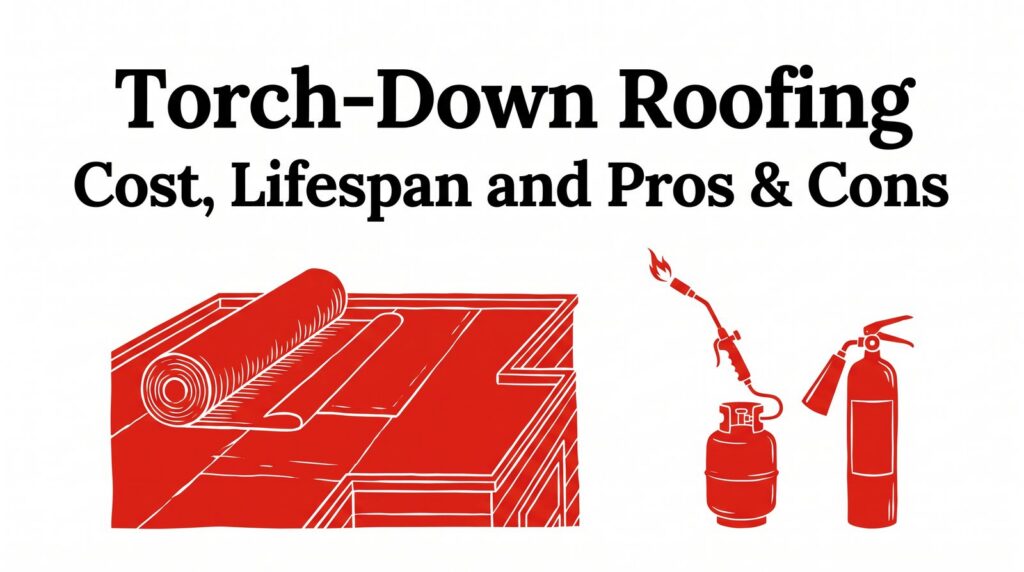
Torch-down roofing is a flat-roof system made of modified bitumen sheets that a roofer bonds to the roof by heating the underside with a propane torch, so the layers fuse into one waterproof membrane. Installed torch-down typically costs about $6–$8 per square foot, or roughly $5,000–$13,500 for a 1,000 sq ft roof. A two-layer system lasts around 15 years and a three-layer system about 20–25 years.
Torch-down has covered flat roofs on San Francisco row houses, Oakland flats and Bay Area commercial buildings for decades. It’s tough and fairly affordable, but it involves an open flame on your roof, and in San Francisco that comes with specific fire department rules. Here’s what it costs, how it compares with the alternatives, and what to ask a roofer before you hire one.
Flat roof leaking or ponding? Call (925) 412-4584 for a flat-roof inspection and a written roof replacement quote. California Roof Pros · CSLB #1158153 · Concord & Danville, CA
What is a torch-down roof?
Torch-down is one way of installing modified bitumen: asphalt blended with rubber or plastic polymers and reinforced with fiberglass or polyester. It comes in rolls about 3 feet wide. The installer unrolls each sheet, heats the back with a torch until the bitumen melts, and presses it down so it bonds to the layer below. Seams overlap and fuse, so the finished roof has no glued joints to come apart.
A typical system has a base sheet fastened to the roof deck and a cap sheet on top with mineral granules that protect it from UV. A three-ply system adds an interply sheet between them.
APP vs. SBS torch-down
| APP (atactic polypropylene) | SBS (styrene-butadiene-styrene) | |
|---|---|---|
| Installed by | Torch only | Torch, hot asphalt, cold adhesive, or self-adhering |
| Behavior | Stiffer, holds up well to heat and UV | More flexible and rubbery, more impact resistant |
| Best fit | Mild climates, smaller roofs | Roofs with movement, or where a no-flame install is preferred |
| Typical cost | About $12.50–$16.25 per sq ft | About $11–$15 per sq ft ($9.25–$14.50 self-adhering) |
Material-type price ranges from This Old House (updated June 2026), which reports higher per-square-foot figures by membrane type than its overall installed average.
How much does torch-down roofing cost?
| Roof size | Typical installed cost | Average |
|---|---|---|
| 1,000 sq ft | $4,900–$13,500 | About $9,200 |
| 1,500 sq ft | $7,300–$15,550 | About $11,400 |
| 2,000 sq ft | $9,650–$26,750 | About $18,200 |
| Repairs | $2.50–$8.50 per sq ft | Patches, blisters, seam repairs |
Source: This Old House, torch-down roofing cost (updated June 2026). Permits typically add $100–$1,000. San Francisco and Bay Area jobs usually price toward the upper end because of labor costs, access and permit requirements.
What pushes the price up
- Tear-off. Removing one or more old layers and hauling them away. California generally limits how many roof coverings can be stacked, and a full tear-off lets the roofer inspect the deck.
- Deck repair. Flat roofs that have ponded for years often have rotted sheathing. See roof decking repair.
- Drainage fixes. Tapered insulation, crickets or new scuppers to stop ponding.
- Parapets, skylights, roof decks and HVAC curbs. Every penetration and wall needs flashing.
- Two-ply vs. three-ply. The extra layer adds cost and about 5–10 years of life.
- A cool-roof cap sheet to meet Title 24 (see below).
How long does a torch-down roof last?
A well-installed two-ply torch-down roof typically lasts about 15 years, and a three-ply system about 20–25 years. What shortens that life on Bay Area roofs:
- Ponding water. Water that sits for more than a couple of days after rain ages the membrane fast. Good drainage matters more than the brand.
- Foot traffic. Roof decks, solar maintenance and HVAC service wear the cap sheet. Walk pads help.
- Poor seams. Under-heated laps open up. Over-heated laps scorch the sheet.
- No maintenance. Clear drains before the rainy season and recoat or touch up granule loss as needed.
Torch-down vs. other flat-roof systems
| System | Typical lifespan | Strengths | Watch-outs |
|---|---|---|---|
| Torch-down (modified bitumen) | 15–25 years | Tough, puncture resistant, fused seams, many roofers know it | Open flame, dark versions run hot unless a cool cap sheet is used |
| TPO / PVC single-ply | 20–30 years | Reflective white surface, heat-welded seams with hot air, no open flame | Less forgiving of foot traffic, quality varies by membrane thickness |
| Spray polyurethane foam (SPF) | 20+ years with recoats | Adds insulation, fixes slope and ponding, popular on Eichlers | Needs a recoat every 10–15 years, installer skill is critical |
| Built-up roof (tar and gravel) | 15–30 years | Proven, multiple layers | Heavy, hot-asphalt install, messy to repair |
For a deeper comparison, see our guide to types of flat roofing materials.
Torch-down in San Francisco: fire department rules
Because torch-down uses an open flame, the San Francisco Fire Department regulates it as roofing hot work. According to SFFD’s fire safety rules for roofing operations:
- Torch work requires an SFFD “Hot Work Operations – Roofer” permit, a C-39 roofing contractor license, a San Francisco business license, and a Department of Building Inspection building permit.
- The contractor must notify SFFD before work starts on the first day.
- A trained fire watch must stay on site for at least one hour after torch work ends.
- An extinguisher (or charged hose) must be on the roof within 10 feet of the torch work.
- Flame may not be applied to wood, insulation, cant strips, flashing, roof voids or behind counterflashing, and torches can’t be used in enclosed areas.
Before you sign, ask any roofer bidding torch-down work in San Francisco to confirm they hold the SFFD roofing hot-work permit. If they don’t, the work can be shut down, and an unpermitted job is a real fire risk on attached row houses. Many roofers now use a self-adhered SBS base sheet near walls and penetrations so no flame goes near wood, and torch only the open field.
Title 24 cool-roof rules for re-roofing
California’s Energy Code (Title 24, Part 6) requires many low-slope roof replacements to use a cool roof: a reflective surface rated by the Cool Roof Rating Council. For low-slope re-roofs in most inland Bay Area and Sacramento climate zones, the target is an aged solar reflectance of at least 0.63 and thermal emittance of at least 0.75. Cooler coastal zones, including San Francisco’s, are generally exempt (Cool Roof Rating Council summary; California Energy Commission).
For torch-down, that usually means a white, CRRC-rated cap sheet or a reflective coating over the cap. Your roofer and the local permit office confirm what applies to your address. In hot inland areas like Concord or Sacramento, a cool cap sheet is worth it anyway, because it keeps the top floor noticeably cooler.
Is torch-down right for your roof?
Torch-down is a good fit when: the roof is flat or very low slope, gets some foot traffic (a roof deck, mechanical equipment), you want a proven, tough membrane at a moderate price, and the installer is licensed and permitted for hot work.
Consider another system when: the roof deck is wood and tightly surrounded by combustible walls and vents where flame is risky, you want maximum reflectivity for the lowest price (TPO), or the roof needs added insulation and slope correction (foam).
Torch-down roofing FAQ
How much does a torch-down roof cost?
Installed torch-down roofing typically costs about $6–$8 per square foot, or roughly $4,900–$13,500 for a 1,000 sq ft roof and $9,650–$26,750 for 2,000 sq ft. Tear-off, deck repair, drainage work and Bay Area labor rates push prices toward the high end.
How long does torch-down roofing last?
About 15 years for a two-ply system and 20–25 years for a three-ply system, assuming good drainage and basic maintenance. Standing water, heavy foot traffic and poorly fused seams shorten its life.
Is torch-down roofing better than TPO?
Neither is better everywhere. Torch-down is tougher under foot traffic and has fused multi-layer seams. TPO is more reflective, often lasts longer, and is installed without an open flame. The roof’s use, drainage and fire-safety constraints decide which fits.
Is torch-down roofing allowed in San Francisco?
Yes, but only by a C-39 licensed roofer holding an SFFD roofing hot-work permit and a building permit. SFFD requires notice before work starts, an extinguisher on the roof, and a fire watch for at least one hour after torching ends.
Can you put torch-down over an existing roof?
Sometimes, if there’s only one existing layer, the deck is sound, and local code allows it. A full tear-off is usually better on older flat roofs because it lets the roofer find and fix rotted decking and drainage problems.
Get a flat-roof quote that’s in writing.
California Roof Pros inspects and replaces flat roofs in San Francisco, Oakland and across the Bay Area and Greater Sacramento, from our Concord and Danville offices. Call (925) 412-4584 or request a quote.
California Roof Pros · 5650 Imhoff Drive, Suite A, Concord, CA 94520 · CSLB #1158153

The CA Roof Pros Editorial Team brings together roofing professionals and experienced content specialists dedicated to providing accurate, practical information about roofing, repairs, maintenance, and replacement. Every article is researched and reviewed to help California homeowners make informed decisions about their roofing needs.